How We Assess Carbon-Crediting Methodologies
Our assessment process ensures methodologies meet the requirements of the Core Carbon Principles Assessment Framework, to help accelerate climate action through high integrity carbon markets
What is a carbon crediting methodology?
A methodology defines the rules and approaches used to measure the emissions reductions and/or removals of a carbon crediting project. Some methodologies share specific characteristics and were grouped into categories for assessment before the Integrity Council began its assessments.
How do we assess carbon crediting methodologies?
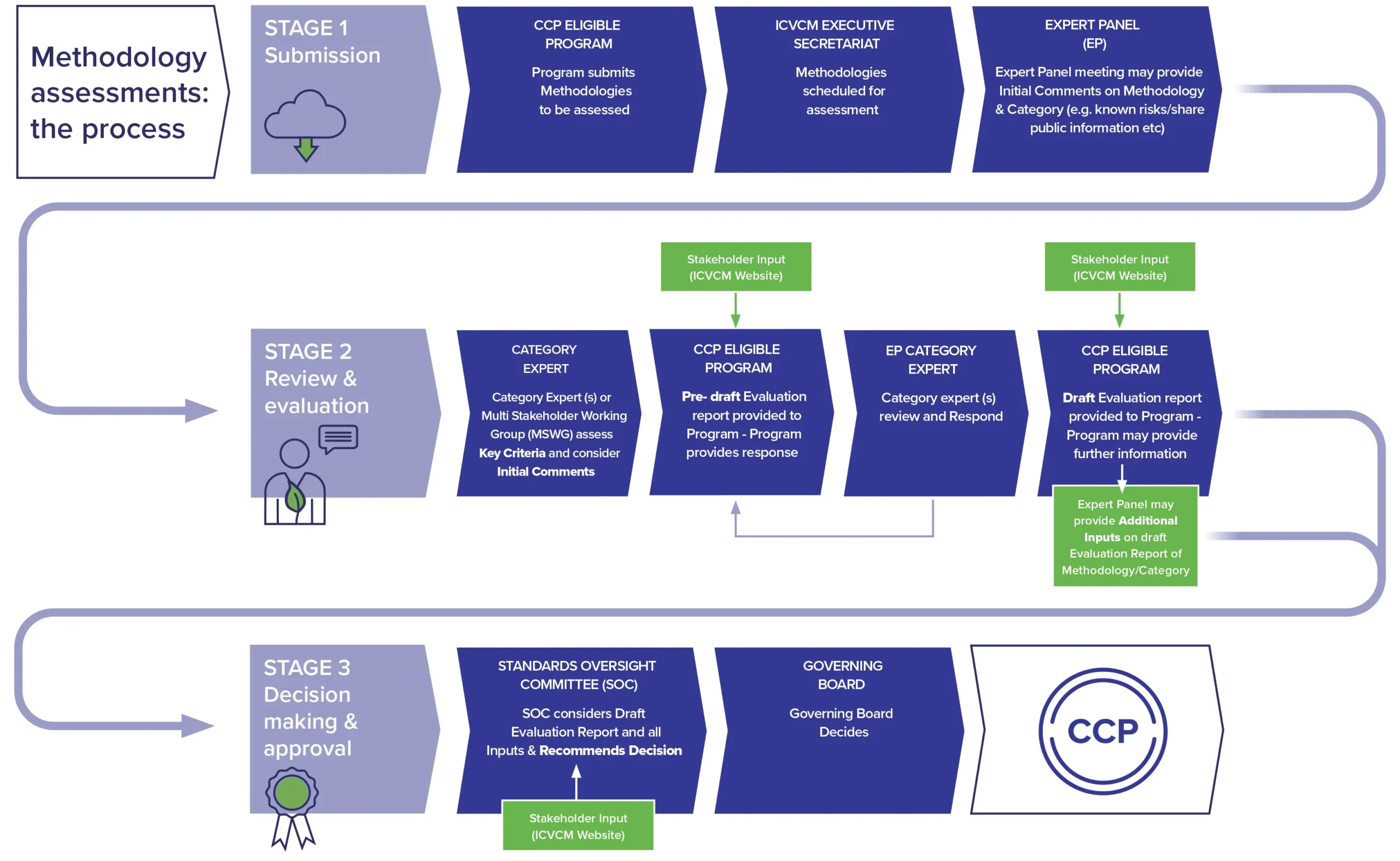
Categories of methodologies are assessed either by individual expert (s) or by Multi-Stakeholder Working Groups against the relevant criteria in the CCP Assessment Framework.
Stage 1: Submission
CCP-Eligible programs submit methodologies for assessment. The Integrity Council Executive Secretariat schedules the methodologies for review, and the Expert Panel meets early on to provide initial comments, clarify the methodology and category, or highlight any known risks. This stage sets the foundation by gathering all necessary information to begin a robust and transparent evaluation process.
Stage 2: Review & Evaluation
The next stage centres on detailed technical assessment. A Category Expert or Multi Stakeholder Working Group reviews the submission against key criteria and considers initial comments from the Expert Panel. The CCP-Eligible program then reviews and responds to a draft evaluation report and any further questions. Stakeholder input may also be collected during this phase. The outcome of this process is a draft evaluation report that may be subject to further review by the Expert Panel and any additional information supplied by the program.
Stage 3: Decision Making & Approval
During the final stage, the Standards Oversight Committee reviews the draft evaluation report and all Stakeholder Input before making their recommendation for a Decision to the Governing Board, who makes the final Decision. This ensures that each Decision taken by the Governing Board is backed by an expert‑led and inclusive governance process.

H2: What requirements are methodologies assessed against?
Emissions
Our emissions criteria ensure carbon credits represent genuine, lasting, and measurable reductions in greenhouse gas emissions.
Emissions criteria include:
Why it matters:
Greenhouse gas emissions reductions or removals from a carbon crediting project must not occur without the incentive created by carbon credit revenues – this is what makes them ‘additional’.
How the Integrity Council assesses:
To comply with the CCP Assessment Framework, carbon-crediting methodologies must demonstrate robust additionality assessments that align with CORSIA criteria and are further strengthened by the Integrity Council’s criteria. This includes a test, or tests that carbon finance is essential for the project to be viable; this can range from investment and barrier analyses to a standardised approach to demonstrate additionality.
Special considerations apply to Jurisdictional REDD+ programs.
Why it matters:
Greenhouse gas emissions reductions or removals from carbon crediting projects must be permanent, or if there is a risk of reversal – either from human actions (e.g., deforestation) or natural events (e.g., wildfires) – projects must address this risk
How the Integrity Council assesses:
The Integrity Council’s approach to permanence ensures that methodologies are designed to deliver long-term greenhouse gas reductions, creating a lasting climate impact. Reversal risks vary by project type and the CCP Assessment Framework reflects this.
Methodologies that represent a high-risk of reversal, such as forest conservation and avoided conversion of ecosystems, require a 40-year monitoring and compensation period, pooled buffer reserves, and clear accountability measures.
Special considerations apply to Jurisdictional REDD+ programs.
Looking forward, the CIWP report on Permanence proposes future refinements to the Assessment Framework, including standardising reversal definitions, piloting stress‑tests of pooled buffers, guidance on risk assessments/data, exploring extensions to the 40‑year period, and a sandbox to trial innovations.
Why it matters:
Accurate quantification of the greenhouse gas emissions reductions and removals achieved by a carbon crediting project is vital. Overstating the impact of credits undermines the credibility of carbon markets and can hinder progress toward global climate goals.
How the Integrity Council assesses:
As with program-level assessment, carbon-crediting methodologies must be based on conservative approaches, completeness and sound scientific methods to ensure they accurately state the emissions impact of credits issued.
Why it matters:
Greenhouse gas emissions reductions or removals from a carbon crediting project must only be counted once – in issuance, claims or use. Double counting undermines the credibility and effectiveness of carbon markets, leading to inflated emissions reductions and diminishing climate benefits.
How the Integrity Council assesses:
The Integrity Council examines whether the methodology sets clear boundaries and definitions that preclude overlaps; requires proponents to identify and resolve co‑located activities, stacked incentives and jurisdictional interactions; prohibits cross‑scheme double crediting; and embeds unique identifiers for data and credits so double issuance or claiming is impossible or detectable during verification. Program registries operationalise enforcement.
Sustainable Development Benefits and Safeguards
These criteria ensure that carbon crediting projects support the transition to net-zero, while prioritising social and environmental sustainability.
Sustainable development benefits and safeguards criteria include:
Why it matters:
Upholding the Sustainable Development Goals (SDGs), driving gender equality and engaging with both Indigenous Peoples and local communities are key components of a high-integrity carbon market that works for both people and the planet.
How the Integrity Council assesses:
The program requires projects to assess and manage negative environmental and social impacts (including biodiversity), engage stakeholders, and disclose how benefits are shared. These requirements are implemented and checked at project design and during ongoing monitoring
Why it matters:
Carbon crediting projects must avoid locking in greenhouse gas emissions, technologies or carbon-intensive practices that are incompatible with the objective of achieving net-zero greenhouse gas emissions by mid-century
How the Integrity Council assesses:
To comply with the CCP Assessment Framework, mitigation activities must not increase fossil fuel extraction, support unabated coal-fired power, or rely solely on fossil-fuel-powered transport. Methodologies must also include assessing compatibility with host countries’ net-zero goals.
Confidentiality
A methodology is the rules and approaches used by a project to reduce and remove emissions and measure the impact of the project. Some methodologies share specific characteristics and were grouped into Categories for assessment before the Integrity Council began its assessments.
Multi-Stakeholder Working Group (MSWG) Membership
MSWGs include external expertise, comprising up to 12 carbon crediting methodology experts, including methodology development and project development1 and up to two members of Indigenous Peoples or local communities. They also include Integrity Council experts, with up to two Integrity Council Standards Oversight Committee Co-Chair and members, and up to three Integrity Council experts.
The following document provides a list of active organisations involved in the Multi-Stakeholder Working Groups.
1These may come from any sector, such as civil society, environmental non-government organisations, commercial, rating experts, carbon-crediting programs, public sector.
ICVCM Consultant Pool
The Integrity Council has set up a consultant pool to support our technical work during an intensive methodology assessment phase.
The Integrity Council began to match its needs with experts in this pool, initially for work that began in May 2025.
- If you have previously submitted an expression of interest and completed a profile that provides detailed information with respect to your sectoral expertise, please contact us.
- If you have only shared a CV, please take five minutes to build a consultant profile through the following link: https://www.surveymonkey.com.
This work will focus specifically on methodological assessment and will be competitively remunerated.
The Integrity Council is committed to fostering a diverse and inclusive membership, including geographical and gender mix and representation from members of both Indigenous Peoples and local communities.

How we assess carbon-crediting programs
Learn about the other part of the ICVCM’s two tick process – the assessment of carbon-crediting programs.

Carbon-Crediting Methodologies Assessment Status
Learn about the CCP-Approved methodologies, and what stage all assessments are currently at.